

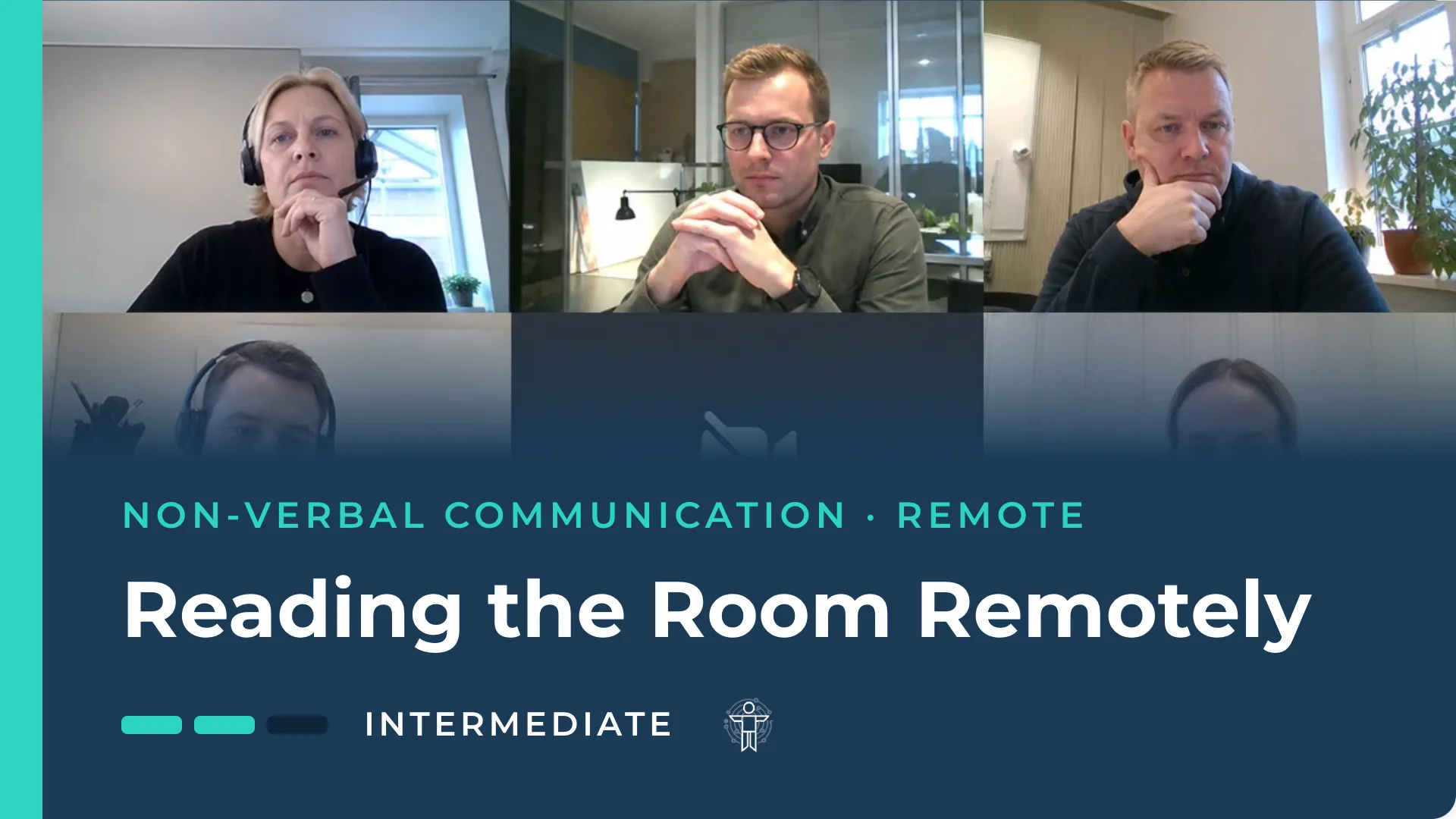
Reading the Room Remotely: Non-Verbal Intelligence for Video Calls
Build a disciplined, evidence-aware method for observing presence, engagement, discomfort and cognitive load when the camera removes much of the body. Managers, salespeople and recruiters progress from camera fundamentals to high-stakes judgement, humane meeting design and informed scepticism about AI-read behaviour.
Choose how much support you want
Same price on this course as every other. The only decision here is the level of guidance.
self-paced in the Academy live with a trainer
Self study
ACADEMYLearn the method at your own pace, on any device.
- All video lessons and materials
- Self-paced, any device
- Exercises + downloadable tools and checklists
- Community access
- AI tutor
- Completion certificate
Cohort
ACADEMYLIVELearn the method, then practise it live with a small group.
- Everything in Self study
- 4 live online group sessions (60 min)
- Guided practice for this course
- AI tutor
- 60-day session recordings
- Guided tasks between sessions
- Small group — max 15
VIP
ACADEMYLIVEPractise it live — private coaching on your real situations.
- Everything in Cohort
- Unlimited live group sessions (60 min)
- 3 private 1:1 sessions with the founder
- Personalised feedback on your real situations
- Priority support
- Personalised action plan
Secure checkout powered by Stripe. Buying for a team of 5 or more? See team pricing
Continuing Professional Development
CPD certified by Open CPD
- Self Study
- 5.5 CPD hours
- Cohort — adds 4 live sessions
- 9.5 CPD hours
Open CPD Reg. ID 620113 · Self Study figure is our own estimate
How our CPD works →What you’ll cover
- →Module 1: Map What Survives the Camera
- →Module 2: Build a Credible On-Camera Presence
- →Module 3: Read Engagement, Fatigue and Disagreement
- →Module 4: Reduce Video-Call Fatigue
- →Module 5: Handle High-Stakes Video Conversations
- →Module 6: Navigate AI-Read Behaviour and Deepfakes
What this course does not claim
Body-language marketing is full of myths. Here is what we deliberately won’t tell you.
- That one gesture “means” one thing, or reveals a lie.
- That you’ll read minds or “detect deception instantly”.
- Any “% of communication is non-verbal” figure.
What you get instead: baseline-and-cluster observation, read in context — noticing more and guessing less.
Course Curriculum
0Welcome to BodyLytics
Your guided introduction to the BodyLytics learning platform — discover interactive features, track your progress, and get the most out of your learning journey.
1.0Map the Video Signal Before Interpreting ItPreview
Before you interpret a pause, gaze shift or posture change on a video call, first identify which channels are actually available. This lesson establishes a disciplined method for separating observable evidence from missing information, using a remote engineering stand-up as the working scenario.
1.1Audit a Meeting Frame by Frame
Practise separating what a camera visibly captures from what you merely assume. Using a fictional European procurement call, you will compare three framings—close face crop, shoulders-up, and wider webcam view—and build a disciplined inventory of observable behaviour without assigning intent, emotion, or truthfulness.
1.2Distinguish Observation from Interpretation
In a video meeting, the same visible behaviour can support several explanations. This activity lesson trains you to separate what the camera shows from what you think it might mean, then apply that discipline to a pharmaceutical project review without turning uncertain cues into accusations.
1.3Apply the Four-Step Reading Protocol
Bring the module together with a disciplined method for interpreting what you see, hear and cannot observe on camera. You will practise moving from observation to baseline, deviation, cluster and context—then choosing a respectful verbal or process response instead of assigning attitude or intent.
1.4Module Test: Camera-Surviving Channels
This assessment brings together the core skills from Module 2: identifying which non-verbal channels survive a camera, separating observation from interpretation, recognising the limits of video-call evidence, and choosing a cautious next step. You will analyse realistic professional scenarios rather than recall isolated definitions. The assessment includes an advanced case-based quiz, matching, fill-in-the-blanks, sorting, and visual cue analysis.
2.0Set Framing, Light and Background for Legibility
Your camera setup is not decoration; it is the viewing environment through which other people interpret your face, posture, gestures and attention. This lesson shows you how to redesign framing, lighting and background so that a recruiter, manager or client can focus on the conversation rather than technical distractions—while keeping clear limits around what an on-camera signal can prove.
2.1Align Eye Line Without Performing Eye Contact
Practise arranging your camera and screen so your gaze can move naturally between the lens, the other person’s face and your notes. You will evaluate three video-call layouts in a financial-services client update, using warmth, credibility, visual comfort and conversational flow as your criteria rather than trying to stare continuously into the camera.
2.2Use Posture and Gesture Space Deliberately
In a video call, your posture and gesture space shape how easily others can interpret your attention, confidence and intent. In this activity lesson, you will establish a natural baseline, refine your camera frame, and practise using visible gestures without turning presence into performance.
2.3Calibrate Presence to Role and Culture
Integrate the module’s camera, posture, eye-line, gesture, rhythm and contextual-reading skills across three culturally distinct professional scenarios. You will practise adapting your presence without turning cultural patterns into stereotypes, using Hall’s proxemics and Morris’s behavioural context as hypotheses rather than rules.
2.4Module Test: On-Camera Presence
This capstone assessment asks you to integrate the presence skills from Module 3: framing, eye line, posture, lighting, visible gestures, vocal delivery and ethical interpretation. You will prepare a two-minute workplace message, analyse your own choices, and complete application-based activities that test whether you can distinguish observable evidence from confident-sounding speculation.
3.0Establish a Remote Baseline
Before you interpret engagement, fatigue or disagreement in a video meeting, you need to know what each person normally looks and sounds like in that setting. This lesson shows you how to build an individual baseline during a low-stakes opening, record observable channels without judging intent, and recognise why remote comparison is less reliable than within-person change.
3.1Track Clusters, Not Single Tells
Practise reading changes in engagement, fatigue and disagreement by combining observable cues with baseline, context and verbal content. You will work through realistic video-call scenarios and rehearse respectful responses that reduce cognitive load without treating non-verbal behaviour as proof of intent or deception.
3.2Respond to Possible Disagreement
Learn to respond when a person’s behaviour shifts from their own baseline without turning an observation into an accusation. Through a progressive set of activities, you will match respectful interventions to situations, classify responses by their likely effect, and complete a final assessment that tests your ability to observe, hypothesise and inquire with disciplined uncertainty.
3.3Read the Group Without Losing the Individual
Integrate baseline observation, comfort–discomfort cues, clusters, context, and humane intervention in a complex remote meeting. You will practise separating observable behaviour from assumptions about motivation, then choose proportionate ways to restore engagement without turning the video grid into a lie detector.
3.4Module Test: Engagement and Disagreement
This capstone assessment brings together the module’s central discipline: establish a person’s baseline, notice meaningful deviations, interpret clusters in context, and respond with proportionate curiosity rather than certainty. You will analyse realistic meeting situations involving engagement, fatigue, disagreement, stress, and competing explanations. The assessment tests observation, reasoning, ethical judgement, and your ability to turn non-verbal evidence into constructive next steps.
4.0Explain Why the Grid Demands Extra Work
Video calls do not simply reproduce face-to-face communication on a screen. They preserve some social signals while distorting or removing others, forcing you to consciously manage gaze, facial expression, posture, attention and self-presentation. In this lesson, you will examine the emerging research on non-verbal overload and learn why a grid of faces can make an ordinary meeting cognitively expensive.
4.1Diagnose Fatigue in a Meeting Design
Practise auditing a demanding customer-success schedule for avoidable cognitive and non-verbal load. You will connect meeting design choices—self-view, face size, turn-taking and scheduling—to the specific demands they place on attention, gaze, posture and social interpretation, while keeping your conclusions appropriately cautious.
4.2Design Camera-Optional Participation
Create a more inclusive cross-border manager forum by separating participation from camera access. You will diagnose non-verbal overload, design explicit alternatives to on-camera presence, and assess engagement through multiple channels rather than treating video visibility as proof of attention.
4.3Run a Humane Meeting Experiment
Bring the module together by designing a one-week, evidence-aware comparison for a sales team. You will distinguish observable evidence from speculation, account for technical and accessibility factors, and test whether small changes reduce non-verbal overload without sacrificing participation or decision quality.
4.4Module Test: Humane Video-Call Design
This assessment asks you to redesign a fatigued team’s meeting series using evidence-grounded reasoning rather than folklore, overconfident body-language interpretations, or unsupported statistics. You will evaluate video-call strain, distinguish observable evidence from inference, choose humane interventions, and define a practical way to assess whether the redesign helps.
5.0Prepare a High-Stakes Observation Plan
Before you interpret behaviour in a remote interview, negotiation or sales call, you need a disciplined observation plan. This lesson shows you how to separate what the camera reveals from what it hides, establish a fair baseline, record clusters in context, and use verbal follow-up rather than unsupported conclusions. You will apply the method to a medical-device recruitment interview where camera quality, disability, anxiety and cultural communication styles could easily distort judgement.
5.1Pace Before You Lead on Camera
Practise matching a counterpart’s communication rhythm respectfully before attempting to guide a high-stakes video conversation. You will work with urgency, posture, vocal pace, turn-taking and structure while avoiding mechanical mimicry or the assumption that one cue proves intent.
5.2Diagnose Sales Friction Without Mind-Reading
Learn to treat pauses, gaze, posture, questions and turn-taking as diagnostic prompts rather than proof of resistance, deception or disinterest. You will practise a structured observe–baseline–deviation–cluster–context method in a Nordic manufacturing software demo, then translate ambiguous signals into precise clarification questions.
5.3Review a Complete High-Stakes Call
Integrate the full remote-conversation protocol by analysing a fictional European sales negotiation from preparation through follow-up. You will practise separating observable behaviour from interpretation, using baseline, clusters and context, testing hypotheses with respectful questions, and documenting uncertainty without turning discomfort into proof of deception or intent.
5.4Module Test: High-Stakes Video Conversation
This capstone assessment asks you to demonstrate disciplined non-verbal intelligence in a realistic remote interview, negotiation, or sales conversation. You will be assessed on observation, baseline-and-deviation reasoning, alternative explanations, adaptive responses, ethical uncertainty, and the quality of your evidence-based debrief—not on your ability to assign fixed meanings to gestures.
6.0Examine What Automated Systems Claim to Read
Learn to separate what a video system can technically measure from what an organisation may infer from that measurement. You will examine claims about facial movement, gaze, posture and vocal prosody, then apply a cautious framework to AI-assisted graduate recruitment decisions.
6.1Test an AI Behavioural Score for Bias and Validity
A fictional vendor report labels a candidate “low-confidence” after analysing video-interview behaviour. You will audit the score as a critical reviewer: testing the baseline, the data captured, alternative explanations, construct validity, transparency, consent, and the right to human appeal before any employment decision is made.
6.2Spot Deepfake and Synthetic-Identity Warning Signs
Practise a proportionate verification protocol for remote supplier onboarding. You will distinguish observable inconsistencies from proof, combine independent identity checks with careful audio-video observation, and make a defensible escalation decision without turning suspicion into accusation.
6.3Design the Ethical Remote Assessment Playbook
In this integration lesson, you will combine contextual observation, expression analysis, spatial awareness, behavioural framing and threat assessment into a fair remote-assessment procedure. You will design safeguards for human judgement, accessibility, AI procurement, synthetic media and uncertainty—without treating any non-verbal cue as proof of deception or intent.
6.4Module Test: AI, Deepfakes and Human Judgement
This capstone assessment asks you to evaluate automated non-verbal judgements without confusing behavioural signals with proof of intent, competence or deception. You will analyse a simulated video-interview case, test your reasoning across several activity formats, and defend a proportionate human-review process that protects fairness, consent and uncertainty.
7.0Complete the Final Exam
This capstone assessment asks you to integrate the course method in one demanding, cross-border case. You will evaluate observable behaviour without overclaiming, design a humane live response, and set ethical limits around automated behavioural scoring and synthetic media.
7.1Course Evaluation
Consolidate the course’s core principles, test your judgment in a remote-work scenario, and share feedback about relevance, realism, accessibility, clarity, and workplace impact.