

Non-Verbal Communication for Leaders: Read the Room, Lead with Presence
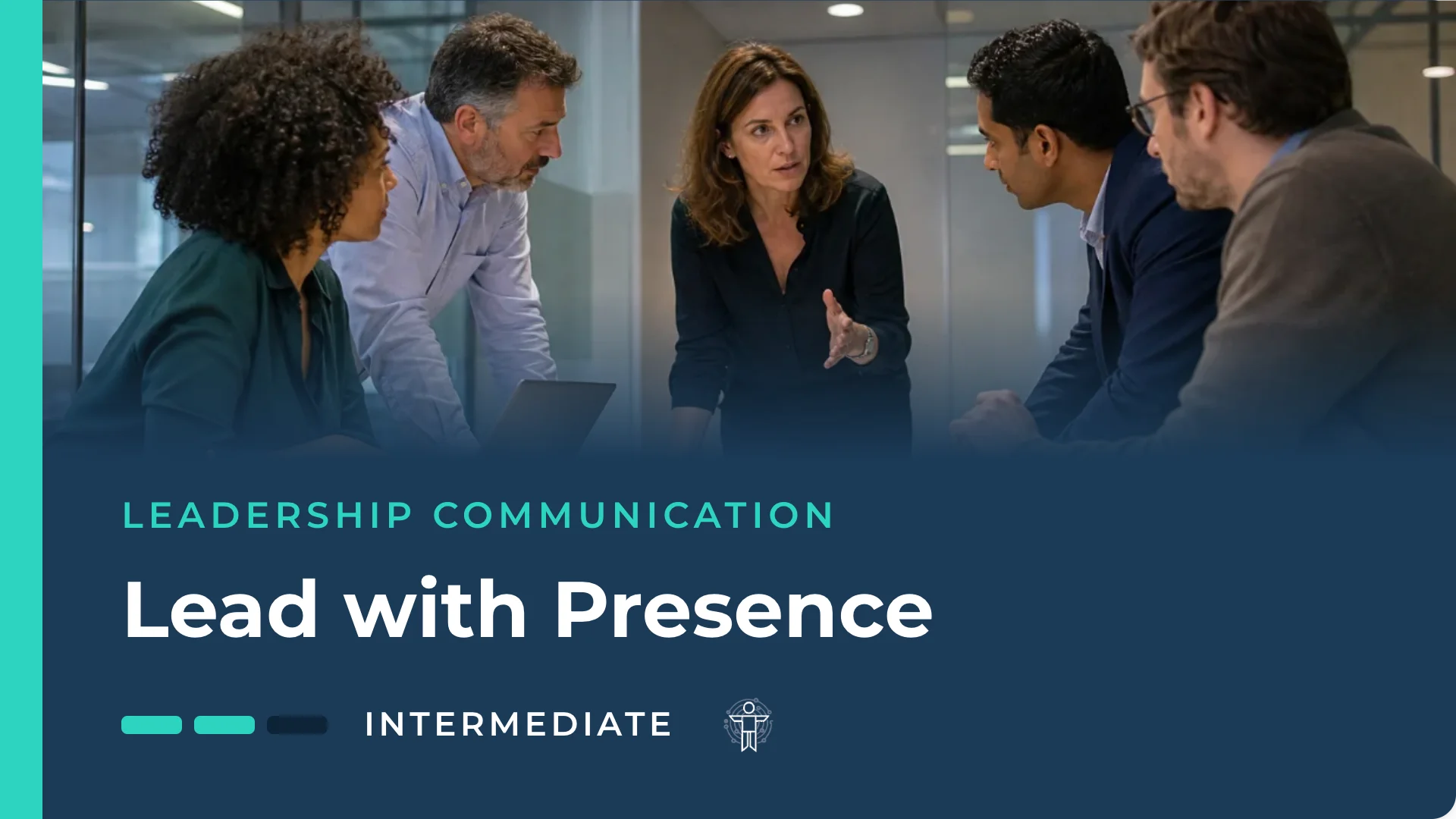
Develop the practical ability to manage the non-verbal signals that shape trust, participation, feedback, and decision-making across European workplaces. Using an observe–baseline–cluster–context method, you will move from managing your own presence to evaluating communication quality across teams, while treating signals as evidence of possible comfort, discomfort, or cognitive load—not as proof of deception or access to private thoughts.
Choose how much support you want
Same price on this course as every other. The only decision here is the level of guidance.
self-paced in the Academy live with a trainer
Self study
ACADEMYLearn the method at your own pace, on any device.
- All video lessons and materials
- Self-paced, any device
- Exercises + downloadable tools and checklists
- Community access
- AI tutor
- Completion certificate
Cohort
ACADEMYLIVELearn the method, then practise it live with a small group.
- Everything in Self study
- 4 live online group sessions (60 min)
- Guided practice for this course
- AI tutor
- 60-day session recordings
- Guided tasks between sessions
- Small group — max 15
VIP
ACADEMYLIVEPractise it live — private coaching on your real situations.
- Everything in Cohort
- Unlimited live group sessions (60 min)
- 3 private 1:1 sessions with the founder
- Personalised feedback on your real situations
- Priority support
- Personalised action plan
Secure checkout powered by Stripe. Buying for a team of 5 or more? See team pricing
Continuing Professional Development
CPD certified by Open CPD
- Self Study
- 8 CPD hours
- Cohort — adds 4 live sessions
- 12 CPD hours
Open CPD Reg. ID 620113 · Self Study figure is our own estimate
How our CPD works →What you’ll cover
- →Broadcasting Leadership Presence
- →Reading the Room in Meetings
- →Creating Safety in One-to-Ones
- →Adapting Feedback in Real Time
- →Detecting Stress and Cognitive Overload
- →Leading Through the Video Grid
- →Analysing Complex Leadership Signals
- →Measuring What You Manage
What this course does not claim
Body-language marketing is full of myths. Here is what we deliberately won’t tell you.
- That one gesture “means” one thing, or reveals a lie.
- That you’ll read minds or “detect deception instantly”.
- Any “% of communication is non-verbal” figure.
What you get instead: baseline-and-cluster observation, read in context — noticing more and guessing less.
Course Curriculum
0Welcome to BodyLytics
Your guided introduction to the BodyLytics learning platform — discover interactive features, track your progress, and get the most out of your learning journey.
1.0Map What Your Leadership Presence BroadcastsPreview
Leadership presence is an observable pattern, not a fixed personality trait. In this lesson, you will learn to distinguish visible behaviour from the story you attach to it, then audit whether your spoken message and non-verbal signals are working together.
1.1Baseline Your Neutral Executive Presence
Before you deliberately project confidence, openness, or authority, you need a reliable picture of your unedited default. In this practice lesson, you will record the same two-minute project update, observe your posture, gaze, gesture rate, breathing, and vocal pace, and separate description from interpretation. You will also prepare for a German–Spanish programme meeting by testing your assumptions against cultural context rather than treating expressive style as evidence of attitude or intent.
1.2Align Words, Body, and Vocal Delivery
Practise a disciplined congruence check for leadership communication. You will learn to notice when words, visible behaviour, and vocal delivery send competing signals—and revise your delivery without treating incongruence as proof of deception.
1.3Rehearse Presence Under Pressure
Integrate the module’s core presence skills in a realistic leadership moment: announcing delayed promotions to a small engineering team in Brussels. You will practise observing without mind reading, maintaining congruence under pressure, and adapting your visible behaviour while preserving honesty and authority.
1.4Module Test: Leadership Presence
This capstone assessment brings together the observation, calibration, and self-management skills from Module 2. You will analyse leadership presence in a realistic workplace scenario, distinguish observable behaviour from interpretation, and demonstrate how you would adjust your non-verbal conduct without overclaiming what another person feels or intends.
2.0Establish a Meeting Baseline
Before you interpret a shift in posture, participation, or attention, you need to know what “normal” looks like for this particular group. In this lesson, you will learn how to observe the opening minutes of a meeting without prematurely judging anyone, then create a practical baseline that allows you to recognise meaningful changes when the agenda becomes difficult.
2.1Track Participation and Energy Shifts
Practise reading a meeting as a changing system rather than decoding isolated gestures. You will build a time-stamped room map, track changes in participation and comfort, and generate several plausible explanations before choosing a respectful intervention.
2.2Cluster Dissent Without Labelling It
Learn to detect emerging dissent in meetings by combining verbal, postural, facial, and timing cues—without turning any single behaviour into a verdict. Practise separating observation from interpretation and formulate neutral check-ins that invite useful disagreement.
2.3Facilitate the Quiet Signal
This integration lesson brings together baseline observation, calibration, comfort–discomfort cues, cognitive-load awareness, cultural humility, and inclusive facilitation. You will practise responding to silence and visible shifts as invitations for better questions—not as proof of resistance, deception, or disengagement.
2.4Module Test: Reading the Room
This capstone assessment brings together the observation discipline developed throughout Module 3. You will analyse a meeting segment, distinguish baseline behaviour from meaningful change, interpret clusters without overclaiming, and choose a facilitation response that preserves dignity and improves the quality of the conversation.
3.0Signal Attention and Psychological Safety
In this lesson, you will examine how leaders communicate attention before they say a word. You will connect torso orientation, device removal, responsive pauses, seating distance, and regulated pacing to safer one-to-ones—while keeping a disciplined distinction between creating conditions for openness and claiming to know what an employee feels.
3.1Baseline an Employee’s Conversational Style
Learn to establish a consent-aware conversational baseline before interpreting changes in an employee’s non-verbal behaviour. You will practise separating meaningful deviations from ordinary variation caused by topic, fatigue, culture, personality, health, or situational pressure.
3.2Spot Possible Disengagement and Invite Detail
Learn to recognise possible disengagement as a context-sensitive cluster, separate observation from interpretation, consider alternative explanations, and invite useful detail without accusation.
3.3Repair Safety After a Misread
Integrate the module’s one-to-one skills by practising what to do when your first interpretation is wrong. You will learn to acknowledge an inaccurate assumption, separate observation from meaning, offer the other person choice, and reset the conversation without becoming defensive or abandoning useful observation.
3.4Module Test: One-to-One Safety
This capstone assessment evaluates whether you can conduct a safer, more informative one-to-one from beginning to end. You will be assessed on baseline observation, comfort–discomfort interpretation, contextual calibration, respectful pacing, response timing, and the quality of your follow-up decision. The aim is not to identify hidden feelings with certainty; it is to make disciplined observations, avoid overclaiming, and create conditions in which the other person can clarify their experience.
4.0Recognise Reception Before You Continue
Learn to detect how corrective feedback is landing in real time by tracking changes across facial tension, posture, breathing, speech, note-taking, and question quality. You will practise treating these changes as interactional information rather than proof of deception, resistance, or poor commitment.
4.1Pause, Check, and Clarify Feedback
Feedback is not a broadcast; it is a live exchange. In this practice lesson, you will learn to notice when a recipient may be processing, confused, uncomfortable, or disengaging, then use brief checks and reflective summaries to adapt without overclaiming what their behaviour means.
4.2Adapt Tone, Pace, and Framing
Learn to treat reception cues as information about the interaction rather than as a verdict on a colleague’s character, honesty, or commitment. You will practise adapting pace, tone, examples, sequencing, and processing time while preserving clarity and accountability in a cross-cultural feedback conversation.
4.3Conduct a Difficult Feedback Simulation
Bring together the module’s observation and adaptation skills in a realistic performance conversation. You will practise distinguishing visible overload from unreliability, using baseline–cluster–context reasoning, and adapting your delivery without diluting a clear expectation.
4.4Module Test: Adaptive Feedback
This capstone assessment evaluates whether you can observe reception cues, distinguish evidence from interpretation, and adapt feedback without overclaiming. You will complete a feedback scenario, explain the cues that prompted your intervention, test comprehension, and identify what remains unknown. The assessment draws on calibration, rapport, contextual observation, cognitive-load indicators, and ethical limits in non-verbal interpretation.
5.0Separate Comfort, Discomfort, and Load
Learn to distinguish observable changes in comfort, discomfort, and cognitive load without turning body language into a diagnosis. Using a Copenhagen incident-review scenario, you will practise baselining behaviour, clustering cues, and responding with supportive process questions rather than assumptions about blame or deception.
5.1Build a Team Strain Baseline
Practise building a repeatable, ethical observation protocol for detecting team-level changes that may indicate stress or cognitive overload. You will work with a remote customer-support scenario and learn to separate observable behavioural change from assumptions about morale, motivation, or truthfulness.
5.2Map Clusters Around Workload Events
Learn to distinguish isolated behaviours from meaningful team-level changes around releases, restructures, and competing priorities. You will analyse a healthcare technology scenario, build a cautious hypothesis map, and practise designing supportive questions that test workload explanations without diagnosing people or treating discomfort as evidence of deception.
5.3Intervene Without Diagnosing
Integrate observation, baselining, clustering, contextualisation, and supportive questioning into a practical workload-reset conversation. You will practise responding to visible changes in participation and capacity without labelling colleagues, inferring illness, or treating discomfort as proof of deception.
5.4Module Test: Stress and Cognitive Load
This assessment brings together the observation, baselining, clustering, contextualising, and ethical-response skills from Module 6. You will analyse a longitudinal team case, distinguish observable behaviour from interpretation, test competing explanations, and choose a proportionate operational response. The assessment draws on Navarro’s comfort–discomfort framework, Ekman’s work on emotional expression, Collett’s account of anxiety responses, and research-informed cognitive-load practices published by BodyLytics Academy.
6.0Calibrate the Remote Baseline
Learn to separate observable remote-meeting variables from the meanings you may be tempted to assign to them. You will examine camera framing, gaze, audio behaviour, latency, chat, multitasking, and physical setup through a cautious, evidence-based lens—especially in culturally and technologically varied hybrid teams.
6.1Read Changes Across the Video Grid
In a remote meeting, the most useful comparison is rarely between people. It is between a participant’s current behaviour and their own established pattern. This practice lesson helps you notice meaningful changes without turning camera status, silence, or reduced gesture into premature conclusions—especially when technical, cultural, workload, and emotional explanations may all fit the same visible cue.
6.2Design Hybrid Participation Signals
A practical activity lesson for making participation, dissent, and processing visible in hybrid meetings without coercing cameras or overinterpreting silence. You will redesign a Paris-based planning meeting using explicit turn-taking, reaction checks, chat prompts, pauses, camera-choice norms, and post-meeting channels.
6.3Run a Remote Difficult-Conversation Simulation
Integrate remote calibration, comfort–discomfort observation, cultural and spatial awareness, and verbal verification in a performance conversation where the video signal is incomplete. You will practise responding to a senior analyst in Helsinki who repeatedly drops from video during a budget discussion—without treating technical disruption, reduced visibility, or discomfort as proof of avoidance or deception.
6.4Module Test: Remote and Hybrid Reading
This assessment integrates the module’s core skills: establishing remote and hybrid baselines, separating technology effects from human behaviour, interpreting camera and audio cues cautiously, and using explicit verbal check-ins when the video grid cannot provide reliable evidence. You will work through applied scenarios, classify observations, and test your judgement about when to adapt the meeting and when to ask directly.
7.0Compare Signals Across Contexts
Learn to interpret non-verbal behaviour by comparing a person with their own baseline, the immediate context, and the demands of the interaction. You will practise separating observation from hypothesis so that a quiet executive is not prematurely labelled deceptive, disengaged, or incompetent.
7.1Construct a Signal-to-Context Decision Trail
Practise separating what you observe from what you infer when a leadership team’s words and behaviour appear inconsistent. Using a Paris-based executive committee delaying a sustainability decision, you will build a five-field decision trail that supports proportionate follow-up without labelling disagreement, deception, or cultural difference as fact.
7.2Evaluate Alternative Explanations
Learn to challenge your first interpretation of non-verbal behaviour by testing technical, cultural, physical, relational, workload, and content-based explanations. You will practise separating what you observed from what you think it means, then choose a proportionate follow-up rather than acting on an unsupported conclusion.
7.3Integrate a Multi-Channel Leadership Case
You will bring together observation, baselining, clustering, contextualisation, pacing, cognitive-load awareness, and ethical follow-up in one complex leadership case. A Brussels transformation director must decide how to respond to a quiet project sponsor without confusing disengagement, overload, strategic caution, cultural preference, or ordinary meeting behaviour with personality. Your task is not to diagnose the sponsor; it is to build a defensible decision trail from observation to hypothesis, action, and outcome.
7.4Module Test: Complex Signal Analysis
This case-based assessment evaluates whether you can analyse complex non-verbal patterns without turning ambiguous behaviour into unsupported conclusions. You will be tested on baseline-setting, clustering, contextual and cultural alternatives, proportionate intervention, and the discipline of stating what the evidence cannot establish.
8.0Define Observable Communication Quality
In this capstone lesson, you will translate non-verbal communication expertise into a responsible team-level measurement practice. You will learn to define observable indicators, distinguish evidence from interpretation, and evaluate whether leadership behaviours are creating better conditions for participation, dissent, clarity, and psychological safety.
8.1Create a Team Observation Protocol
Design a proportionate, ethical observation protocol that helps a regulated-finance team improve interaction quality without turning body-language practice into surveillance. You will translate observation principles into consent, role clarity, baseline notes, contextualised evidence, confidentiality, and safe escalation boundaries.
8.2Measure Change Without Fabricating Certainty
Turn a promising coaching story into a defensible, bounded evaluation. You will build a pre-, during-, and post-training evidence plan for a Madrid engineering department, distinguish observable behaviour from interpretation, and test whether improved meetings can reasonably be attributed to the intervention without overstating what the data proves.
8.3Design the Leadership Communication Capstone
Bring the module together by designing a six-week, evidence-aware intervention for a multinational European energy team that is failing to surface delivery risks. You will connect observation, baselining, clustering, context, rapport, proxemics, presence, ethical interpretation, and outcome measurement into one practical leadership system—without treating non-verbal behaviour as proof of truth.
8.4Module Test: Measuring Communication Quality
This capstone assessment asks you to turn individual observation skill into a responsible team-level practice. You will design and defend an observation and evaluation plan with measurable behaviours, a credible baseline, clear data boundaries, intervention logic, feedback processes, and an honest interpretation of expected results.
9.0Final Exam: Non-Verbal Leadership Practice
This practical final exam assesses whether you can move responsibly from observation to leadership action across live, one-to-one, feedback, stress, and hybrid-work scenarios. You will be evaluated on baseline quality, cluster analysis, contextual reasoning, ethical restraint, adaptive communication, and the design of a credible team-level measurement approach. The assessment draws on Navarro’s comfort–discomfort framework, NLP pacing and leading, perceptual positions, the Meta Model, and evidence-based observation principles.
9.1Course Evaluation and Final Reflection
Consolidate the course, test your judgment in realistic leadership situations, and share feedback about your learning experience.