Free Preview
Recognise the Arrival Signal Set
Learn to observe the arrival moment with discipline: describe what you can actually see before assigning meaning. Using a rainy-evening arrival at a fictional Copenhagen hotel, you will examine posture, hands, gaze, facial expression, orientation and distance while accounting for baseline, culture and context.
The First Few Seconds Are Data, Not a Verdict
The movements of expression in the face and body, whatever their origin may have been, are in themselves of much importance for our welfare.
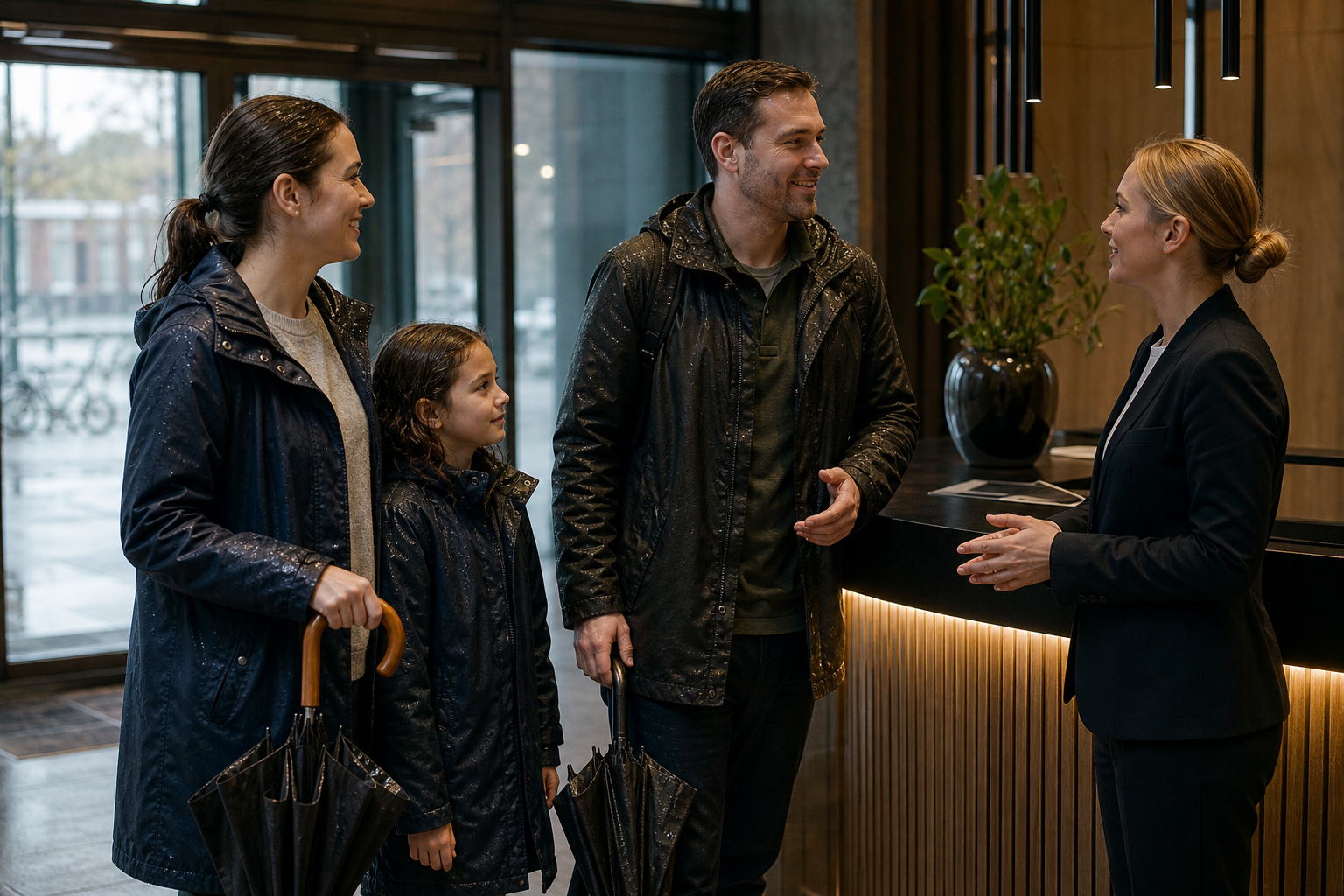
A family enters a Copenhagen hotel on a wet winter evening. One adult moves quickly toward reception, a child stays close to the other adult, and the group briefly scans the lobby before stopping. You may feel an immediate impression—tired, hurried, uncertain, perhaps even unhappy—but professional observation begins by resisting the urge to turn that impression into a conclusion. The arrival moment is a scene to document, not a personality test.
Module orientation
By the end of this lesson, you will be able to...
Observation Before Interpretation
Observation answers the question, ‘What did the person do?’ Interpretation answers, ‘What might that behaviour mean?’ These are related but different mental operations. ‘The father’s shoulders are raised and his hands remain inside his coat pockets’ is an observation; ‘he is anxious’ is an interpretation that may be plausible, but it is not directly visible. Keeping the two statements separate protects you from overconfidence and helps you choose a response that remains respectful if your first hypothesis is wrong.
The Six-Part Arrival Signal Set
A useful arrival scan has six observable channels: posture, hands, gaze, facial expression, orientation and distance. These channels are not six independent answers; they are more like instruments in an orchestra. A single violin note may be ambiguous, while several instruments changing together can reveal that the interaction has shifted. Even then, the result is a working hypothesis rather than proof of emotion, intent or truthfulness.
A cue is a prompt for curiosity, not a verdict
Weather, Culture and the Copenhagen Lobby
The fictional Copenhagen arrival is deliberately set on a rainy evening because context changes the meaning of many visible behaviours. Wet coats can create hunched shoulders, umbrellas occupy both hands, cold air can tighten facial muscles, and luggage can force a family into a compact cluster. Cultural expectations also shape comfortable distance and gaze; the source describes how differing European and Australian spatial norms produced mutual misreadings even when neither party intended anything negative †1Body Language How to Read Others Thoughts by Their Gestures, pp.23-24. A careful observer records the conditions before interpreting the people.
Sequence for Observing and Responding to Arrivals
- 1
Step 1: State the Visible
First state what is visible.
- 2
Step 2: Check Situational Explanations
Then check situational explanations such as weather, luggage, crowding, language and family roles.
- 3
Step 3: Analyze Channel Convergence
Next ask whether several channels change together or whether you are reacting to one isolated cue.
- 4
Step 4: Decide on Response
Only then decide whether to offer space, simplify the welcome, ask a neutral question or proceed normally.
The Family’s Arrival: A Worked Observation
At 18:40, a family of four enters through the revolving door. One adult walks directly to the reception desk with a suitcase, keeps the chin slightly lowered and looks at the illuminated sign above the desk; the second adult pauses to remove a wet hood, while two children remain close together and look toward the seating area. The first adult’s hands are occupied by luggage, the second adult’s hands are visible while adjusting the hood, and the group’s bodies gradually orient toward reception. These are descriptions, not conclusions.
Several interpretations remain possible. The direct approach may indicate time pressure, confidence in what the family needs or simply that this adult is managing the booking; the lowered chin may reflect rainwater, fatigue, reading the sign or uncertainty. The children’s proximity may reflect tiredness, unfamiliar surroundings or ordinary family coordination. A service professional could greet the group warmly from a respectful distance, acknowledge the booking party, and allow the family’s next movements and verbal response to provide more evidence.
Practise the Neutral Arrival Record
Create three columns in your notes: ‘What I saw’, ‘What it might mean’ and ‘What else could explain it’. For example, write ‘guest rubs the side of the neck after the receptionist states the deposit amount’ in the first column. In the second, you might record ‘possible uncertainty or discomfort’; in the third, include ‘itch, cold skin, collar irritation or a moment of thought’. This structure keeps your attention active without allowing your first story to become a fact.
From Observation to a Respectful Service Move
Your response should be proportionate to the evidence. If the family looks around repeatedly but remains oriented toward the desk, a simple ‘Good evening—may I help you find reception or check in?’ gives them an easy way to clarify their need. If one adult steps back when you approach, pause at that distance rather than following immediately. If a guest’s hands are occupied by wet clothing and luggage, offer practical assistance instead of reading the hidden hands as a character signal.
Professional translation
Your Arrival Observation Discipline
Discipline for Responsible Frontline Practice
- 1
Phase 1: Document Visible Facts
Before you label an arrival as warm, guarded, hurried or uncertain, write at least three visible facts.
- 2
Phase 2: Identify Baseline and Context
Then identify the baseline you have—or acknowledge that you do not yet have one—and list one situational and one cultural explanation that could alter your reading.
- 3
Phase 3: Determine Appropriate Service Behavior
Finally, decide what small service behaviour would remain appropriate even if your preferred interpretation were wrong.
Carry this forward
Enjoying this lesson?
Sign up for free to access the full course, track your progress, earn certificates, and join our community of learners.